Abbott Diabetes Care Inc v Sinocare Inc & Ors [2025] EWHC 206
Written by Bethan Clarke James | August 1, 2025
In a recent High Court ruling, a leading provider in the continuous glucose monitoring (“CGM”) sector, saw its legal claims against Sinocare dismissed. The Court found that Abbott’s three-dimensional trade mark was invalid, deeming it both functionally necessary and lacking acquired distinctiveness, undermining its attempt to block Sinocare’s entry into the UK market with a similarly shaped product.
Background
Abbott registered a three-dimensional shape mark in December 2022 for a key component of its CGM system. When Sinocare launched its iCan i3 device in January 2024, Abbott filed a trade mark infringement claim under sections 10(2)(b) and 10(3) of the Trade Marks Act 1994 (“TMA”), alongside a passing off claim. Abbott alleged that the shape of Sinocare’s product was confusingly similar to its own, risking brand dilution and unfairly piggy-backing onto Abbott’s market reputation.
Sinocare counterclaimed that Abbott’s mark was invalid because the shape lacked distinctive character (s.3(1)(b) TMA) and served a technical function (s.3(2)(b) TMA).
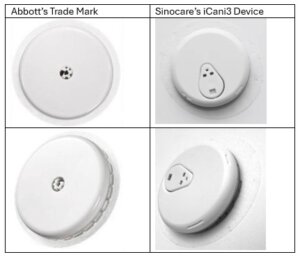
Why Abbott’s Claim Failed
The Court decisively sided with Sinocare, highlighting two core findings:
- Lack of Acquired Distinctiveness
Despite Abbott’s market prominence, the Court was unconvinced that consumers associated the specific 3D shape with the company. Use in the market, regardless of how widespread the use is, wasn’t sufficient without strong evidence of consumer recognition. Abbott failed to cross this evidentiary threshold. - Functionality Beats Form
The Court agreed with Sinocare that the contested shape served a technical function in CGM systems. Under section 3(2)(b) TMA, this made the mark unregistrable.
Importantly, the Court also found no actual consumer confusion and noted that Sinocare’s product was clearly branded with distinct marks, further undercutting Abbott’s infringement and passing off arguments.
Take-away
This ruling is an important reminder that trade mark law will not shield designs that are inherently functional, no matter how widely used. Protection of such elements may be better pursued through designs or patents (but it is worth flagging that these face hurdles with regard to time-limited exclusivity and functional necessity).